
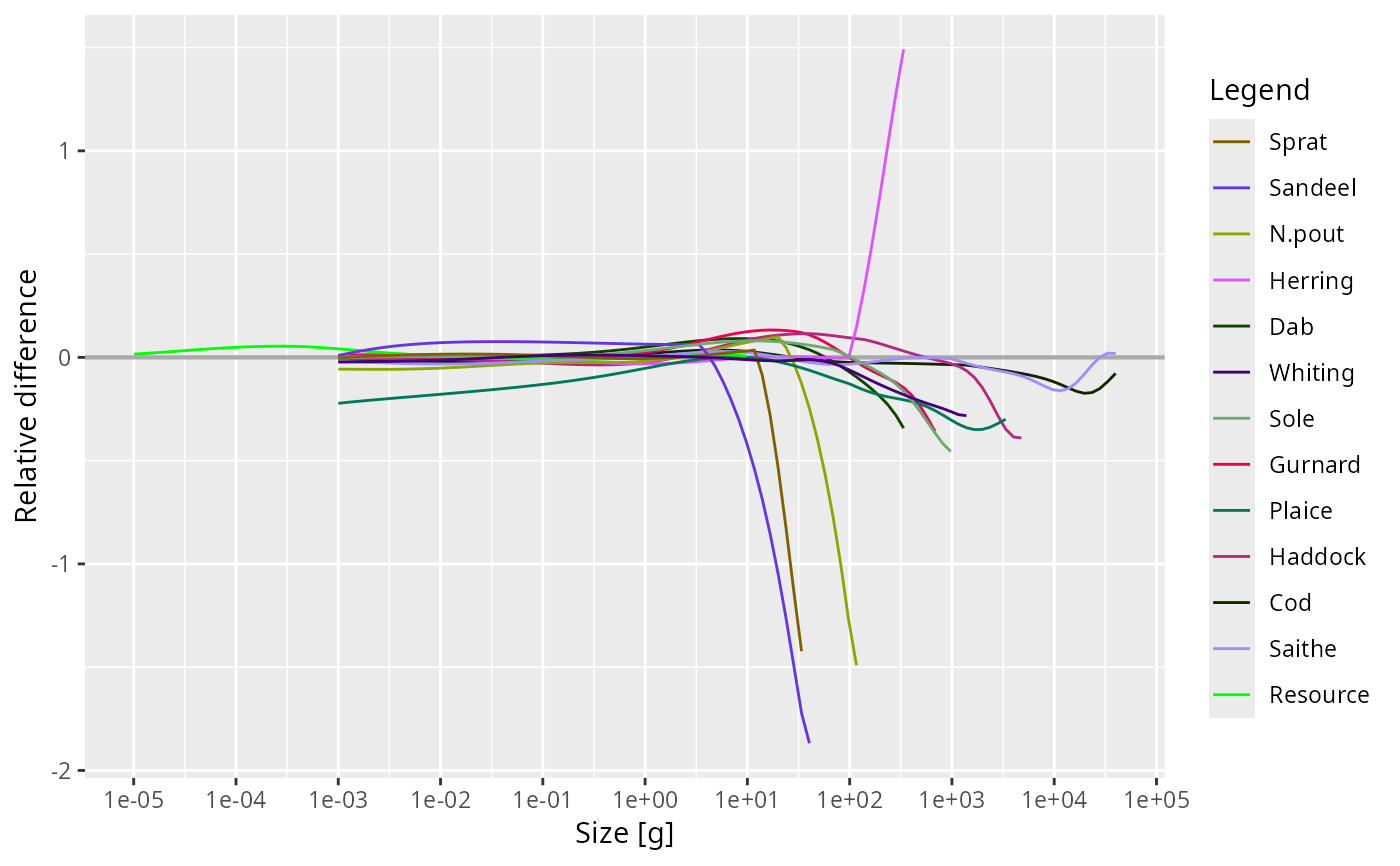
plotSpectraRelative() plots the difference between the spectra relative to
their average. If we denote the number density from the first object as
\(N_1(w)\) and that from the second object as \(N_2(w)\), then this
plot shows
$$2 (N_2(w) - N_1(w)) / (N_2(w) + N_1(w)).$$
Note that it does not matter whether the relative difference is calculated
for number density, biomass density, or biomass density in log weight,
because the factors of \(w\) by which the densities differ cancel out in
the relative difference.
Arguments
- object1
First
MizerParamsorMizerSimobject.- object2
Second
MizerParamsorMizerSimobject.- species
The species to be selected. Optional. By default all target species are selected. A vector of species names, or a numeric vector with the species indices, or a logical vector indicating for each species whether it is to be selected (TRUE) or not.
- wlim
A numeric vector of length two providing lower and upper limits for the w axis. Use NA for the default: the lower default is
min(params@w) / 100whenresource = TRUE(to show some resource below the fish grid) ormin(params@w)whenresource = FALSE; the upper default ismax(params@w_full). Data is filtered to this range and the axis limits are set accordingly.- llim
A numeric vector of length two providing lower and upper limits for the length axis when
size_axis = "l". UseNAto auto-scale to the data range. Data is filtered to this range and the axis limits are set accordingly.- ylim
A numeric vector of length two providing lower and upper limits for the y axis (the relative difference). Use
NAto refer to the existing minimum or maximum.- total
A boolean value that determines whether the total is plotted as well. The total is the total of everything the object holds — every species and the resource — whatever is drawn, so it does not move when
species,resourceorbackgroundchange. Default is FALSE.- resource
A boolean value that determines whether resource is included. Default is TRUE.
- background
A boolean value that determines whether background species are included. Ignored if the model does not contain background species. Default is TRUE.
- highlight
Name or vector of names of the species to be highlighted by being plotted with thicker lines.
- log_x
If
TRUE(default), use a log10 x-axis.- size_axis
Whether to plot size as weight (
"w", default) or length ("l"), using the allometric weight-length relationship. Spectrum densities and their units are transformed to match the chosen axis.- ...
Additional arguments passed to
plotSpectra()for preparing the spectra data, for exampletime_rangeorgeometric_meanforMizerSimobjects.
See also
plotting_functions, plotSpectra(), plotSpectra2()
Other plotting functions:
addPlot(),
animate(),
plot,
plot2(),
plotBiomass(),
plotCDF(),
plotCDF2(),
plotDiet(),
plotFMort(),
plotFeedingLevel(),
plotGrowthCurves(),
plotMizerParams,
plotMizerSim,
plotPredMort(),
plotRelative(),
plotSpectra(),
plotSpectra2(),
plotYield(),
plotYieldGear(),
plotYieldVsF(),
plotting_functions
Examples
# \donttest{
sim1 <- project(NS_params, t_max = 10, progress_bar = FALSE)
#> ℹ No `a` column so using a = 0.01 in w = a l^b, with w in g and l in cm.
#> ℹ No `b` column so using the isometric default b = 3 in w = a l^b.
sim2 <- project(NS_params, effort = 0.5, t_max = 10, progress_bar = FALSE)
#> ℹ No `a` column so using a = 0.01 in w = a l^b, with w in g and l in cm.
#> ℹ No `b` column so using the isometric default b = 3 in w = a l^b.
plotSpectraRelative(sim1, sim2)
 # }
# }