
You will usually not need to call this function directly. Instead change
the relevant species parameters (pred_kernel_type, and, depending on its
value, the parameters required by the selected kernel) with
given_species_params(params) <- and let mizer recalculate the predation
kernel for you. Call setPredKernel() directly only if you want to supply
the full kernel array yourself. See
vignette("guide-change-parameters") for a full explanation of when
to reach for which level of the model.
Usage
setPredKernel(params, pred_kernel = NULL, reset = FALSE, ...)

pred_kernel(params)

pred_kernel(params) <- value
Arguments
- params
A MizerParams object
- pred_kernel
Optional. An array (species x predator size x prey size) that holds the predation coefficient of each predator at size on each prey size. If not supplied, a default is set as described in section "Setting predation kernel".
- reset
If set to TRUE, then the predation kernel will be reset to the value calculated from the species parameters, even if it was previously overwritten with a custom value. If set to FALSE (default) then a recalculation from the species parameters will take place only if no custom value has been set.
- ...
Unused
- value
pred_kernel
Value
setPredKernel(): A MizerParams object with updated predation kernel.
pred_kernel(): An array (predator species x predator_size x
prey_size)
Details
The predation kernel determines the distribution of prey sizes that a
predator feeds on. It is used in getEncounter() when calculating
the rate at which food is encountered and in getPredRate() when
calculating the rate at which a prey is predated upon. The predation kernel
can be a function of the predator/prey size ratio or it can be a function of
the predator size and the prey size separately. Both types can be set up with
this function.
Setting predation kernel
Kernel dependent on predator to prey size ratio
If the pred_kernel argument is not supplied, then this function sets a
predation kernel that depends only on the ratio of predator mass to prey
mass, not on the two masses independently. The shape of that kernel is then
determined by the pred_kernel_type column in species_params.
The default for pred_kernel_type is "lognormal". This will call the function
lognormal_pred_kernel() to calculate the predation kernel.
Alternative pred_kernel types are "box", implemented by box_pred_kernel(),
"power_law", implemented by power_law_pred_kernel(), and
"gaussian_mixture", implemented by gaussian_mixture_pred_kernel(). These
functions require certain species parameters in the species_params data
frame. For the lognormal kernel these are beta and sigma, for the box
kernel they are ppmr_min and ppmr_max, and for the Gaussian mixture they
are the list-columns kernel_p, kernel_mean, and kernel_sd. They are
explained in the help pages for the kernel functions. Except for beta and
sigma, no defaults are set for these parameters. If they are missing from
the species_params data frame then mizer will issue an error message.
You can use any other string for pred_kernel_type. If for example you
choose "my" then you need to define a function my_pred_kernel that you can
model on the existing functions like lognormal_pred_kernel().
When using a kernel that depends on the predator/prey size ratio only, mizer
does not need to store the entire three dimensional array in the MizerParams
object. Such an array can be very big when there is a large number of size
bins. Instead, mizer only needs to store two two-dimensional arrays that hold
Fourier transforms of the feeding kernel function that allow the encounter
rate and the predation rate to be calculated very efficiently. However, if
you need the full three-dimensional array you can calculate it with the
pred_kernel() function.
Kernel dependent on both predator and prey size
If you want to work with a feeding kernel that depends on predator mass and prey mass independently, you can specify the full feeding kernel as a three-dimensional array (predator species x predator size x prey size).
You should use this option only if a kernel dependent only on the predator/prey mass ratio is not appropriate. Using a kernel dependent on predator/prey mass ratio only allows mizer to use fast Fourier transform methods to significantly reduce the running time of simulations.
The order of the predator species in pred_kernel should be the same
as the order in the species params dataframe in the params object. If you
supply a named array then the function will check the order and warn if it is
different.
Higher-order quadrature
When the predation kernel depends only on the predator/prey mass ratio, the
encounter and predation rates are evaluated as convolutions using the fast
Fourier transform. By default mizer point-samples the kernel at the grid
nodes, which is a first-order (rectangle-rule) quadrature. When the
bin_average entry of the second_order_w slot is TRUE, the kernel is
instead integrated over each logarithmic size bin when building the
Fourier-transformed kernels. This finite-volume consistent quadrature lifts
the encounter and predation rates towards second order at no extra runtime
cost, because the integration is performed once here and the rate functions
themselves are unchanged. The predation kernel is additionally averaged over
the prey bin (a trapezoid fold), so that the predation rate returned by
getPredRate() is the prey-bin average that the predation-mortality sink
needs to be second order. The default remains the first-order scheme so that
existing models are unaffected. Enable it with second_order_w(params) <- TRUE (see second_order_w()), which also turns on the other bin-averaged
rate quadratures so the whole model stays consistent. See the
vignette("fft") for the mathematical details.
See also
Other functions for setting parameters:
gear_params(),
setExtDiffusion(),
setExtEncounter(),
setExtMort(),
setFishing(),
setInteraction(),
setMaxIntakeRate(),
setMetabolicRate(),
setParams(),
setReproduction(),
setSearchVolume(),
species_params(),
use_predation_diffusion()
Examples
## Set up a MizerParams object
params <- NS_params
## If you change predation kernel parameters after setting up a model,
# this will be used to recalculate the kernel
species_params(params)["Cod", "beta"] <- 200
## You can change to a different predation kernel type
species_params(params)$ppmr_max <- 4000
species_params(params)$ppmr_min <- 200
species_params(params)$pred_kernel_type <- "box"
plot(w_full(params), pred_kernel(params)["Cod", 100, ], type="l", log="x")
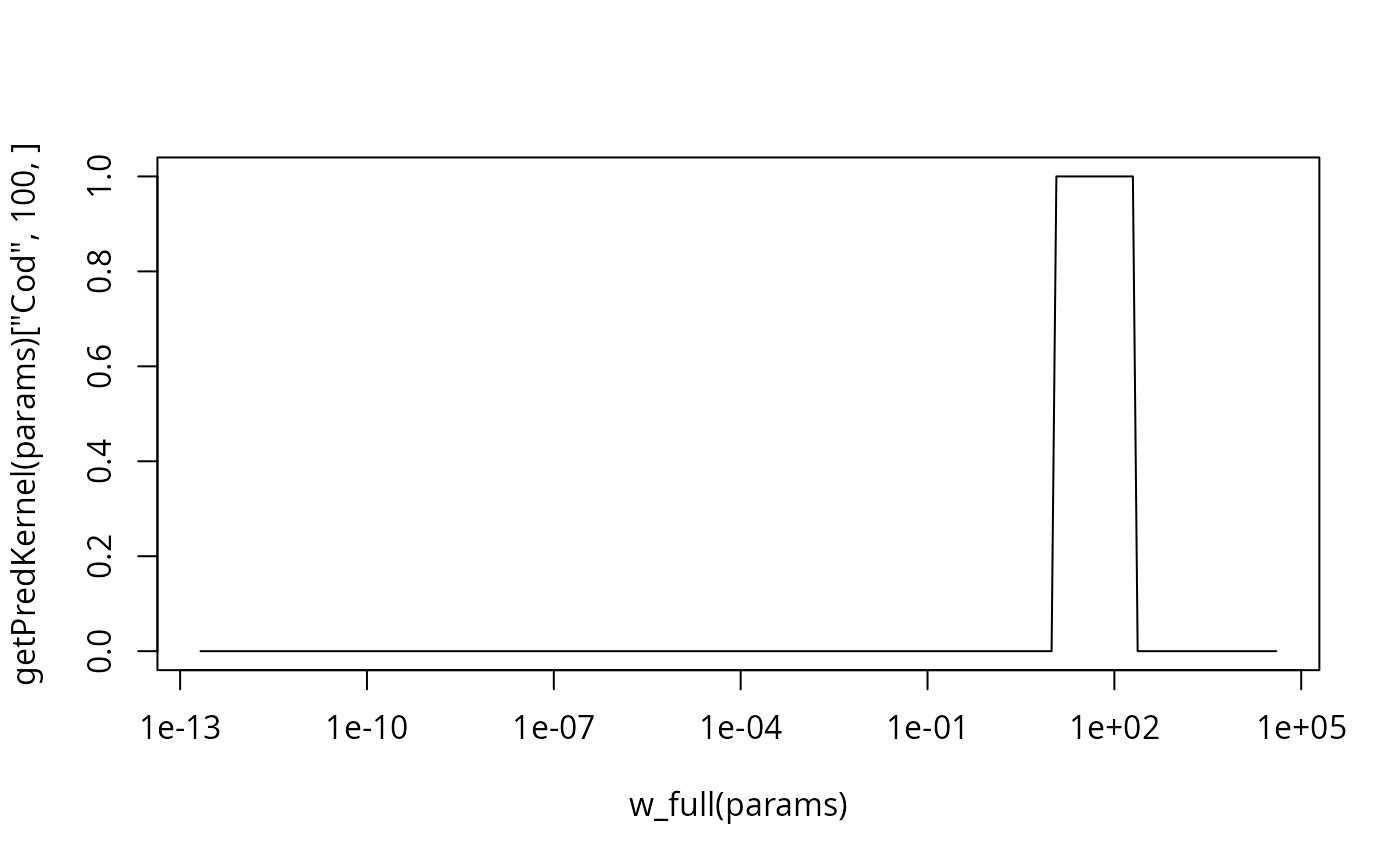 ## If you need a kernel that depends also on prey size you need to define
# it yourself.
pk <- pred_kernel(params)
pk["Herring", , ] <- sweep(pk["Herring", , ], 2,
params@w_full, "*")
params<- setPredKernel(params, pred_kernel = pk)
## If you need a kernel that depends also on prey size you need to define
# it yourself.
pk <- pred_kernel(params)
pk["Herring", , ] <- sweep(pk["Herring", , ], 2,
params@w_full, "*")
params<- setPredKernel(params, pred_kernel = pk)