
![[Experimental]](figures/lifecycle-experimental.svg) Draws the result of a
Draws the result of a scanModel() run: the measured quantity against the
quantity that was scanned, with a band showing the range the quantity takes
over the attractor wherever that attractor is not a fixed point.
Arguments
- x
A
MizerScanobject.- species
The species to show. By default all series in the scan.
- style
One of
"ribbon"(default: the average as a line inside the band),"envelope"(lines along the edges of the band, no average) or"line"(no band).- highlight
Name or vector of names of the species to be highlighted with a thicker line.
- log_x, log_y, log
Whether to use logarithmic axes, see
parsePlotLog().- xlim, ylim
Numeric vectors of length two giving the axis limits. Use
NAto refer to the existing minimum or maximum.- y_ticks
The approximate number of ticks desired on the y axis.
- reference_lines
Whether to draw the reference lines stored in the scan, or a named numeric vector of x positions to draw instead.
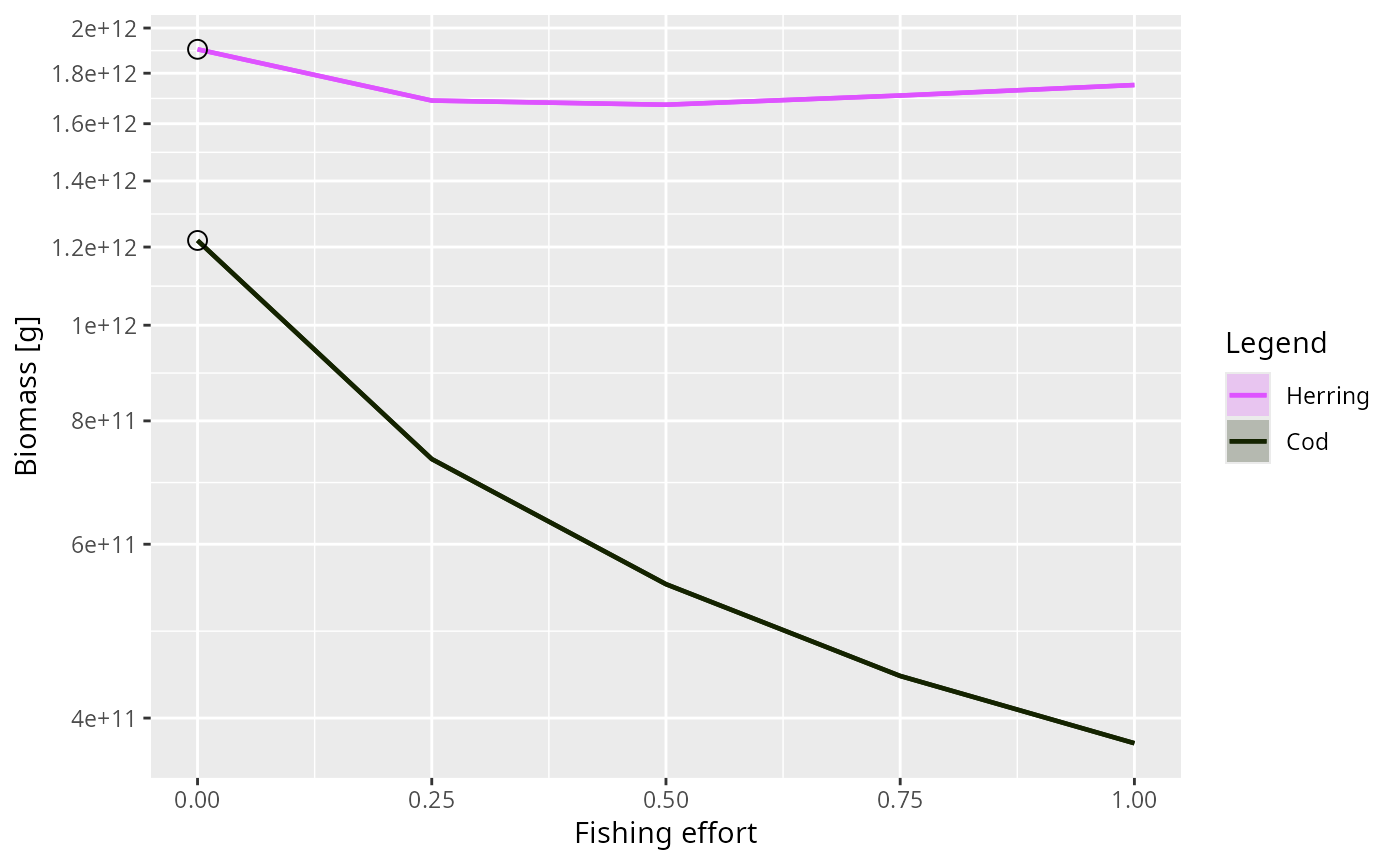
- mark_max
Whether to mark, for each series, the scanned value at which the measured quantity is largest. See
MizerScan().- show_unsettled
Whether to mark the scan values where the model did not settle onto an attractor.
- return_data
Whether to return the data frame used for the plot instead of the plot itself.
- ...
Unused.
Value
A ggplot2 object, unless return_data = TRUE, in which case the data
frame used for the plot is returned.
Details
A model that settles on a fixed point contributes a single value, so the band has zero width there. A model that settles on a limit cycle contributes the average over one period as the line and the range over that period as the band, so a Hopf bifurcation shows up as the scan value at which the band opens up.
Scan values where the model reached neither a fixed point nor a limit cycle within the time allowed are marked with a cross, because the value plotted there is only an average over the last few years of a run that was still changing.
See also
scanModel(), MizerScan(), plotting_functions
Other scan functions:
MizerScan(),
plotYieldVsF(),
scanEffort(),
scanModel()
Examples
# \donttest{
scan <- scanModel(NS_params, scan_values = seq(0, 1, 0.25),
set_func = scanEffort(), species = c("Cod", "Herring"))
#> ℹ No `a` column so using a = 0.01 in w = a l^b, with w in g and l in cm.
#> ℹ No `b` column so using the isometric default b = 3 in w = a l^b.
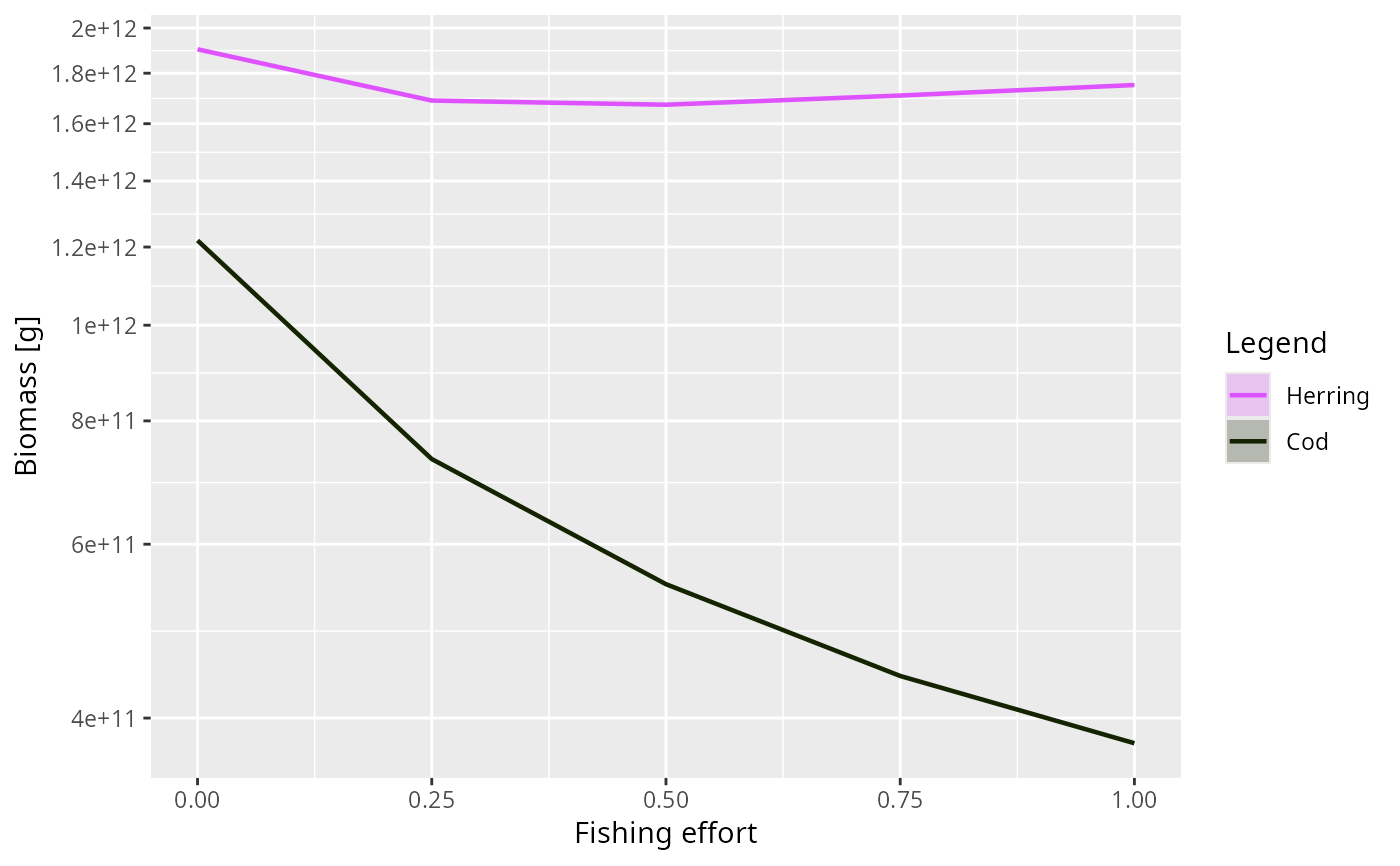
plot(scan)
 plot(scan, style = "envelope", mark_max = TRUE)
 # }
# }