Set up parameters for a single species in a power-law background
Source:R/newSingleSpeciesParams.R
newSingleSpeciesParams.Rd![[Experimental]](figures/lifecycle-experimental.svg)
This functions creates a MizerParams object with a single
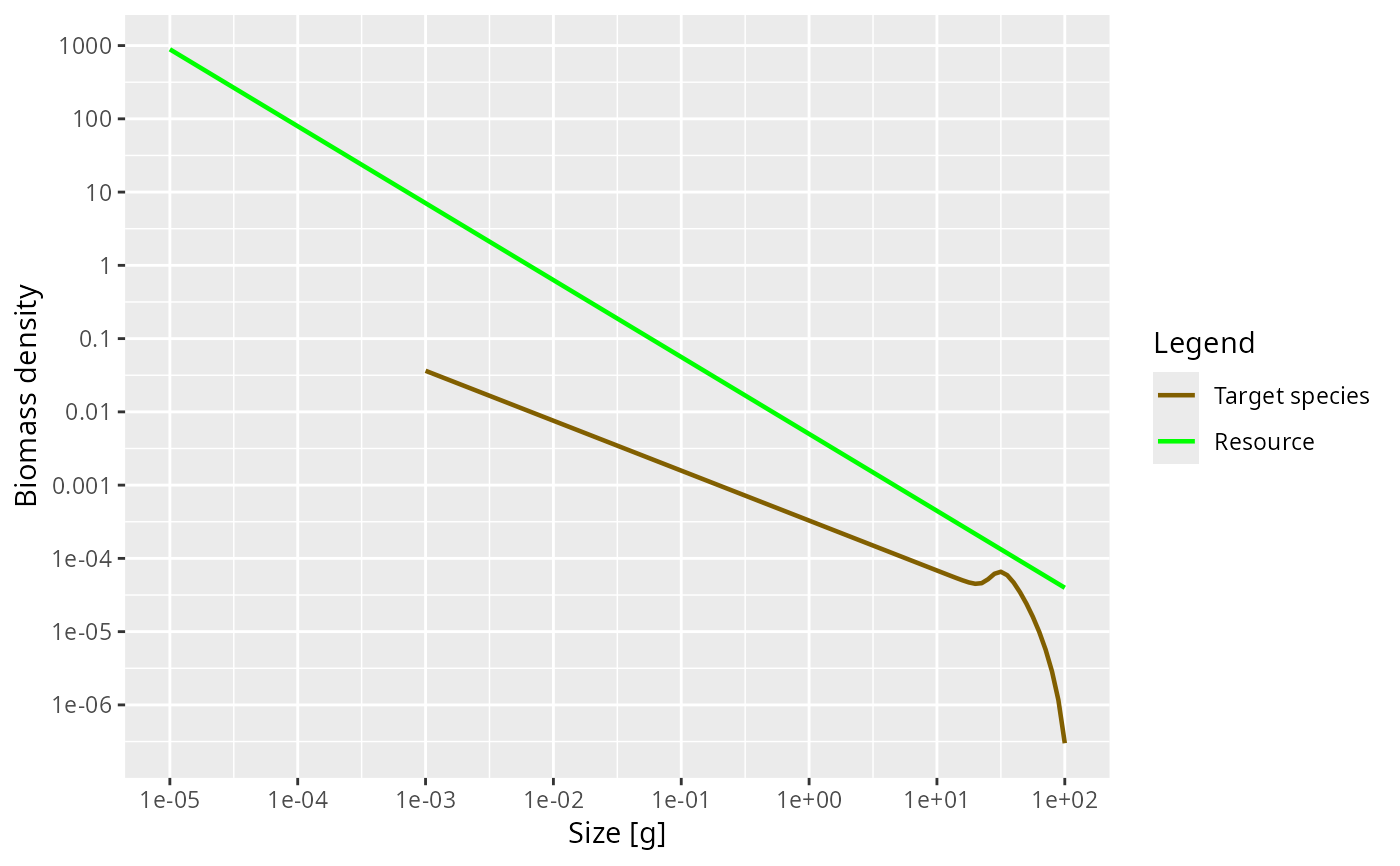
species. This species is embedded in a fixed power-law community spectrum
$$N_c(w) = \kappa w^{-\lambda}$$
This community provides the food income for the species. Cannibalism is
switched off. The predation mortality arises only from the predators in the
power-law community and it is assumed that the predators in the community
have the same feeding parameters as the foreground species. The function has
many arguments, all of which have default values.
Usage
newSingleSpeciesParams(
  species_name = "Target species",
  w_max = 100,
  w_min = 0.001,
  eta = 10^(-0.6),
  w_mat = w_max * eta,
  no_w = log10(w_max/w_min) * 20 + 1,
  n = 3/4,
  p = n,
  lambda = 2.05,
  kappa = 0.005,
  alpha = 0.4,
  h = 30,
  beta = 100,
  sigma = 1.3,
  f0 = 0.6,
  fc = 0.25,
  ks = NA,
  gamma = NA,
  ext_mort_prop = 0,
  reproduction_level = 0,
  second_order_w = FALSE,
  info_level = default_info_level(),
  R_factor = deprecated(),
  w_inf = deprecated(),
  k_vb = deprecated()
)
Arguments
- species_name
A string with a name for the species. Will be used in plot legends.
- w_max
Maximum size of species
- w_min
Egg size of species
- eta
Ratio between maturity size
w_matand maximum sizew_max. Default is 10^(-0.6), approximately 1/4. Ignored ifw_matis supplied explicitly.- w_mat
Maturity size of species. Default value is
eta * w_max.- no_w
The number of size bins in the community spectrum. These bins will be equally spaced on a logarithmic scale. Default value is such that there are 20 bins for each factor of 10 in weight.
- n
Scaling exponent of the maximum intake rate.
- p
Scaling exponent of the standard metabolic rate. By default this is equal to the exponent
n.- lambda
Exponent of the abundance power law.
- kappa
Coefficient in abundance power law.
- alpha
The assimilation efficiency.
- h
Maximum food intake rate.
- beta
Preferred predator prey mass ratio.
- sigma
Width of prey size preference.
- f0
Expected average feeding level. Used to set
gamma, the coefficient in the search rate. Ignored ifgammais given explicitly, but must still be finite and in the interval (0, 1).- fc
Critical feeding level. Used to determine
ksif it is not given explicitly.- ks
Standard metabolism coefficient. If not provided, default will be calculated from critical feeding level argument
fc.- gamma
Volumetric search rate. If not provided, default is determined by
get_gamma_default()using the value off0.- ext_mort_prop
The proportion of the total mortality that comes from external mortality, i.e., from sources not explicitly modelled. A number in the interval [0, 1).
- reproduction_level
A number between 0 and 1 that determines the level of density dependence in reproduction, see
reproduction_level<-().- second_order_w
- Selects the
second-order numerical scheme for the new model, applied before the
resource and abundance power laws are constructed so that they are built
bin-averaged from the start. Accepts the same values as the
second_order_w()setter. Defaults toFALSE. SeenewMultispeciesParams(). - info_level
Controls the amount of information messages that are shown. Higher levels lead to more messages,
info_level = 0gives silence. The default is taken from themizer_info_leveloption, seedefault_info_level().- R_factor
![[Deprecated]](figures/lifecycle-deprecated.svg) Use
Use
reproduction_level = 1 / R_factorinstead.- w_inf
- The argument has been
renamed to
w_max. - k_vb
- The von Bertalanffy growth
parameter.
Details
In addition to setting up the parameters, this function also sets up an initial condition that is close to steady state, under the assumption of no fishing.
The function rounds no_w to the nearest integer and increases it if
necessary so that there are at least 5 size bins per factor 10 in body
size. It requires w_min < w_mat < w_max, ext_mort_prop in [0, 1),
positive values for n, lambda, kappa, alpha, h, beta, sigma
and f0, and fc between 0 and f0 if fc is supplied. If gamma is
supplied then f0 is ignored after its value has been validated. The
function stops if the resulting feeding level is not sufficient to maintain
the species.
The returned model has a single foreground species with cannibalism switched
off and a fixed power-law background community that provides both food and
predation mortality. The initial species spectrum is scaled so that its
maximum abundance is half the background abundance at the corresponding
size, and erepro is then adjusted so the initial state satisfies the egg
boundary condition.
The diffusion rate is set to 0. Because growth is therefore deterministic,
no individual grows beyond w_repro_max, the size at which all available
energy is invested into reproduction. The upper boundary of the size grid is
therefore placed at that size, so that w_max = w_repro_max, instead of the
1.5 * w_repro_max headroom that newMultispeciesParams() leaves to
accommodate the stochastic growth produced by diffusion. This choice will be
revisited once these constructors gain a diffusion parameter, see
https://github.com/sizespectrum/mizer/issues/339.
See also
Other functions for setting up models:
newCommunityParams(),
newMultispeciesParams(),
newTraitParams()
Examples
params <- newSingleSpeciesParams()
sim <- project(params, t_max = 5, effort = 0)
plotSpectra(sim)